Solution
Empowering Next-Generation AI and Data Centers



1.6T Transceiver: What They Are and Where They Fit in Next‑Gen AI Data Centers
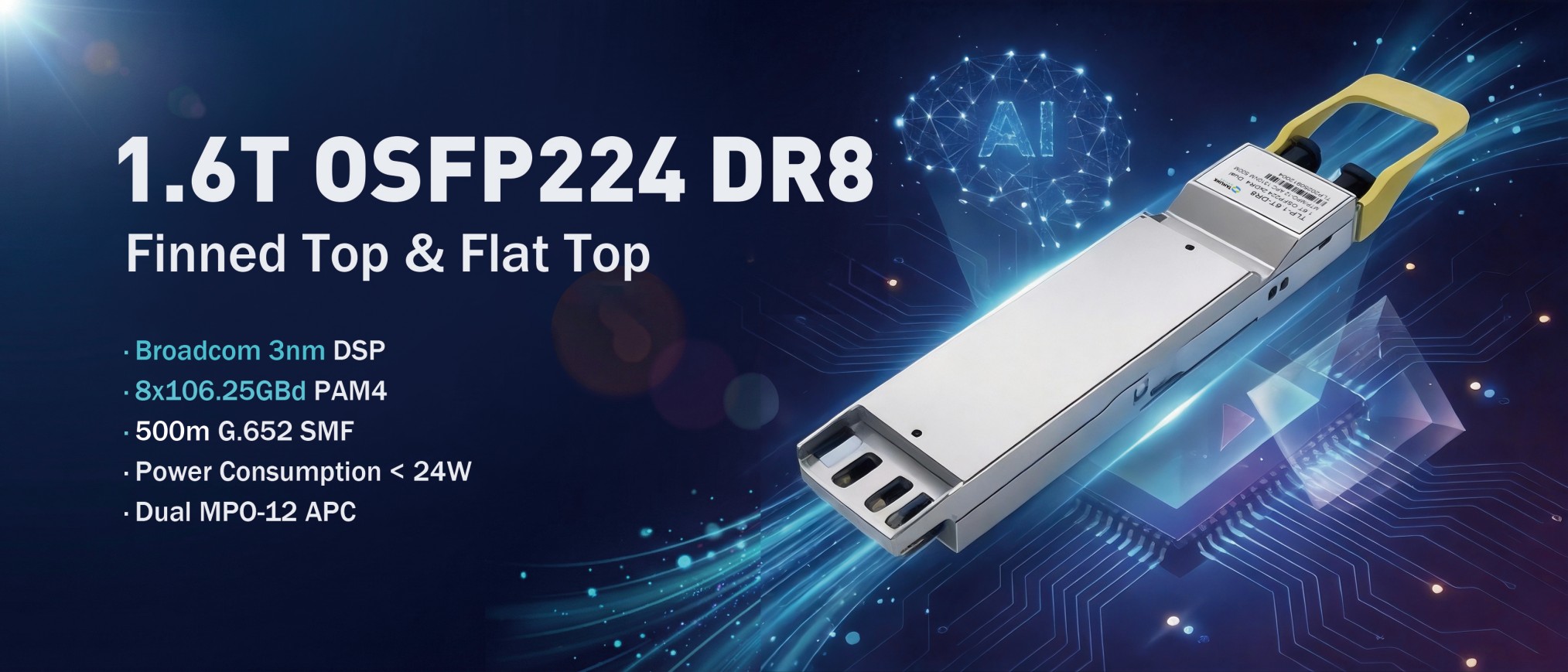
As AI clusters scale, networks are moving beyond 800G toward 1.6T (1.6 Tb/s) links to keep GPUs and storage fed with data. Tanlink Optics launched 1.6T 2xDR4/DR8 OSFP224 IHS/Closed Finned Top PAM4 1310nm 500m SMF DOM Dual MPO-12/APC InfiniBand XDR Transceiver.
Features:
Hot-pluggable 1600G OSFP DR8 form factor
Compliant with OSFP MSA, close top housing
Compliant with CMIS Rev 5.2
Built-in DDMI function
Silicon photonics MZM solution
8x106.25GBd PAM4 electrical and optical interface
Maximum link length of 500m G.652 SMF fiber
Single 3.3V power supply
Operating case temperature 0°C to +70 °C
Power dissipation < 25W
Dual MPO-12 APC receptacles
Compliant with RoHS 2.0
Data center and cloud networks
1600G Ethernet and InfiniBand XDR
Support applications: 1x1600G,2x800G,4x400G, 8x200G
What “1.6T OSFP” Means
OSFP (Octal Small Form-factor Pluggable) is a high-density transceiver form factor designed for very high bandwidth. In 1.6T generations, a common architecture is 8 electrical lanes at 200G-class PAM4 per lane (often referred to as OSFP224 / 224G lane signaling in the ecosystem). The result is an aggregate line rate around 1.6 Tb/s, aimed at switch-to-switch and switch-to-accelerator fabrics in hyperscale and HPC environments.
1.6T OSFP DR8: Parallel Single‑Mode Optics for Short‑Reach 500m Fiber
DR8 generally refers to an optical interface that uses 8 parallel single‑mode fibers (Tx/Rx paths are handled via MPO multi-fiber connectors). In a typical 1.6T DR8 module, the transceiver converts high-speed electrical lanes into parallel optical channels at 1310 nm, delivering high bandwidth over short-reach single-mode fiber.
Some 1.6T designs support splitting the bandwidth into multiple lower-speed links (for example, a 1.6T interface supporting two independent 800G-class logical links in certain platforms). This is often used to simplify migrations where parts of the fabric remain at 800G while core links move to 1.6T.